
Let’s start with the bad news first…
There’s no real benchmark for profit margin in construction that you need to aim for.
Margins fluctuate depending on the industry, the area you’re in, how well the business is run, your financial decisions, your business model, and more.
You could be…
- A large GC making 3% and be perfectly fine if you're high volume, high turn around, low overhead and very low risk...
- Or you could be a mom & pop GC and struggle to get by with 15% margins.
In reality, what’s important is how to increase your construction company profit margins.
And there’s a few things you could do…
6 Tips To Grow Your Contracting Business Profit Margins
#1. Charge What You need to charge
There’s always be a Chuck in a Truck that undercuts you, and you can’t play that game.
Figure out the margins your business needs to grow, and slowly find ways to build that into what you charge.
Dive deep into your bookkeeping and figure it out.
#2. Add 10-15% Overhead On Everything
Gas, rent, marketing, salaries, consumables, and many other, all pile up.
We hear most of our clients add 10-15% on every project to cover their overhead.
If you feel your overhead is larger, do the math and add that to your bids.
#3. Know your work force productivity
Bidding low on labor means you don’t how productive your crews are, and you need to figure it out.
This is easy to do. See by how much you’re underbidding labor in a percentage, then add that percentage in the future.
You can even do it incrementally until you have it nailed down.
#4. At least 30% mark-up on all materials
30% mark-up on materials is standard from what we’re seeing from our clients. Of course, if the numbers make sense, you can do more.
And don’t feel bad about it. Sourcing materials, ordering, helping the client choose, safekeeping them in your warehouse, measuring, etc., still takes time and work, so you better take that into account.
Always add markup after sales tax of the materials.
#5. Cut Down From Waste and Overhead
Generally, every dollar you add to your overhead will take 5 dollars in sales to cover it.
The good news is that your overhead is something you have full control of.
You can limit overtime, limit fuel usage outside working hours, limit work trucks usage, replace what’s possible with AI assistants, outsource aspects of the job instead of having someone on payroll, and more.
#6. Sub your labor needs
On payroll, you only need a heavy-management team.
You can subcontract all your labor work force and you’ll save a lot of money on salaries.
There are quite some differences between 1099 and W-2 workers, so be sure to get more information before you decide which way you’ll go.
profit Margins Vs Mark Up In Construction
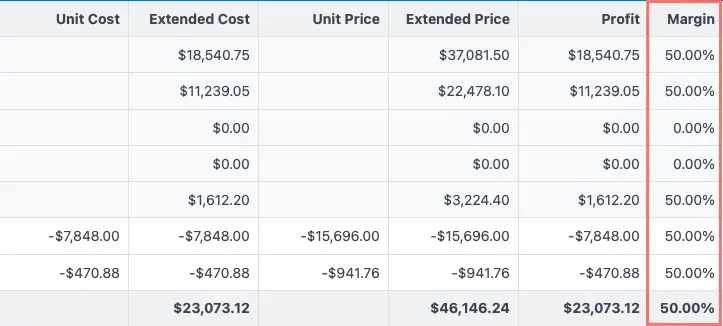
Margin is the % of profit you make. If your margin is 25%, you know 25 ¢ of every $1 goes toward overhead and true profit.
The Different Margins In Different Industries
Profit margins in construction are different based on sector, area you serve, your business model, and many other things.
However, these are some percentages we see at our clients…
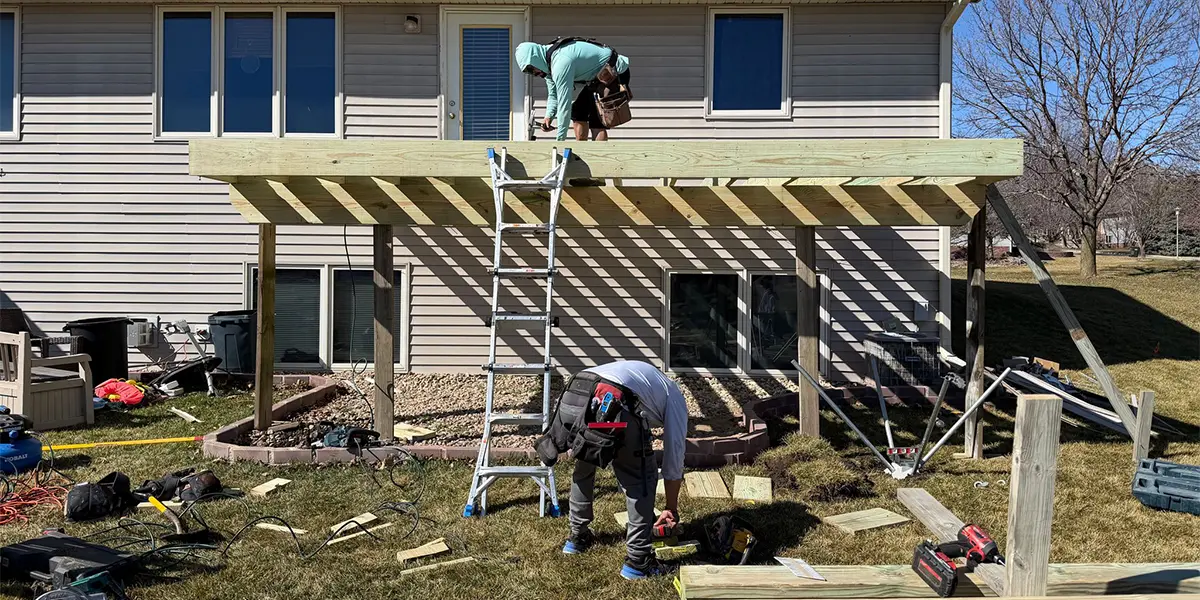
- for decking companies: between 30 and 50% margins
- for remodeling: between 15 and 45%
- for landscapers: between 50 and 75%
- for painters: between 30 and 55%
How can contractors get margins like these or higher?
They focus on getting the type of clients that see the value in their work and not price shoppers who want the lowest bid.
Move Volume Vs More Margins In Construction
At the end of the day, you’re a business and your goal should be to make more money, not work more.
If you get more work volume but your margins remain low, that’s just more hassle that’s simply not worth it.
Your goal should be to dial in your numbers…
Reach a healthy profit margin that allows you to grow the business…
Then focus on getting move volume with the same high margins.
The Right Mark up To Get A Sweet Profit Margin
As I said, there’s no magic number, but bare minimum should be 35-40% profit on every job, with small exceptions.
The equation we’re seeing a lot of contractors from different trades use is this:
You take the profit margin you want and you divide your costs by the opposite.
- Want 40% margin? Divide your costs by .6
- Want 60% margin? Divide your costs by .4
Larger projects should be minimum 35-40% margin. Smaller projects like repairs and door installs should be 60-70%.
Markup vs Profit Calculator
Play around with this simple calculator to see how much you should markup your project to get your desired profit margin.
To reach the desired margin, markup materials and increase labor prices.
Please note that this calculator doesn’t take into account your overhead.
3 Mistakes General Contractors Make With Their Profit Margins
Markup is NOT profit margin
The cost of something is $10 and I added a $5 on top, for a 50% markup. Markup is how much more you’re charging, compared to what you paid.
The sale price is $15, of which $5, or 33.3% is my margin. Margin is how much of the sale price you get to keep as profit.
Don't Compete On Pricing
Don't follow any benchmark
Ready To Grow Your Construction Business?
Your construction company profit margins is a great tell if your business is ready for growth or not.
- If your profit margins are healthy, then you can look into expanding, getting a higher volume of leads, and even opening a second office somewhere in the country.
- If your margins are too low, growth is not sustainable and you'll need to work on your numbers.
All of the contractors we work with operate with over 40% margins regardless of the industry.
We help them achieve that with a powerful brand that people trust regardless of the price they charge.
And then, when it’s time for growth, we help them double or triple their number of leads with result-driven SEO, a high-conversion website, PPC, and Facebook ads.
Want to see how contractors are slowly moving away from word of mouth to a more independent and efficient lead generation system? Watch our Market Domination Blueprint, specifically designed for U.S. contractors.